
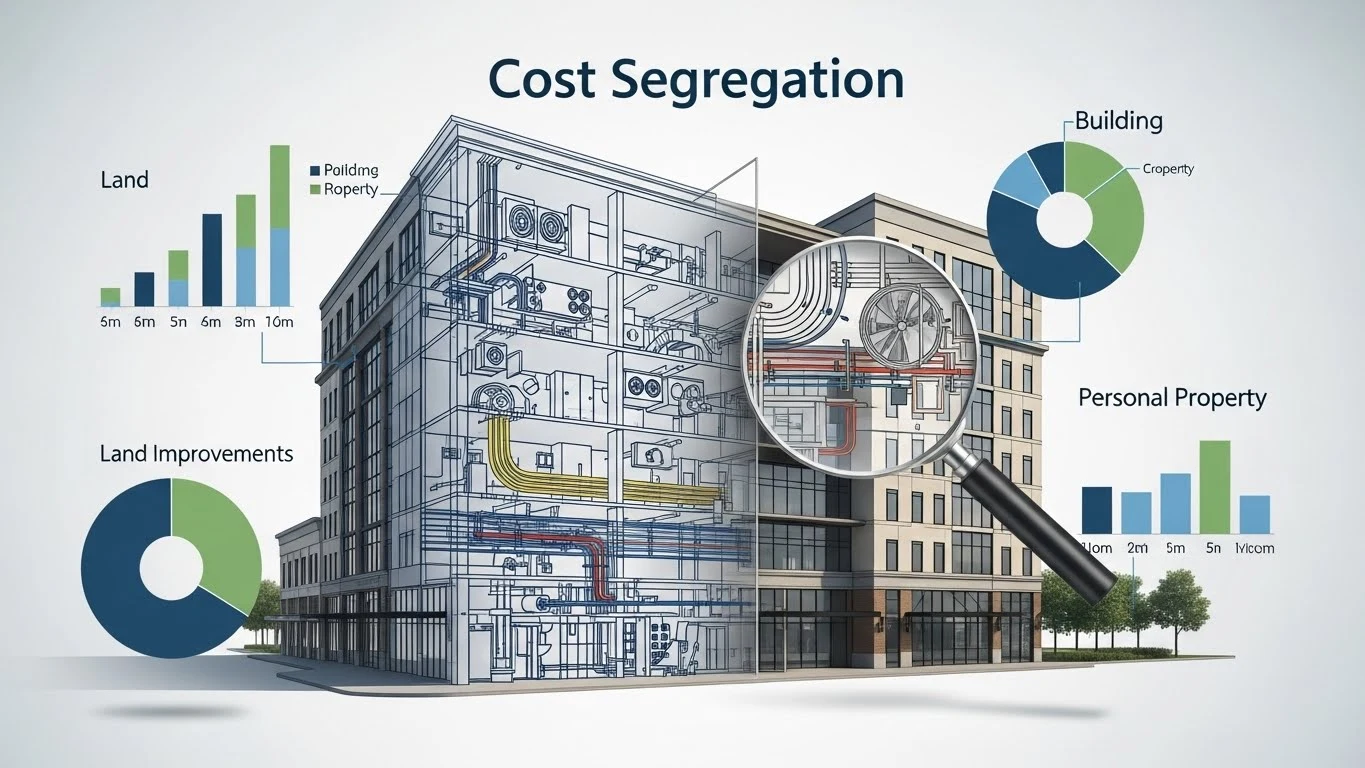
Cost segregation studies are getting more attention in 2026 because the rules of the game are shifting. Interest rates remain high, and investors are feeling the squeeze on margins. In this climate, every dollar of early tax savings counts.
This article explains what a cost segregation study is, why it’s relevant now, and how it can put more cash in your pocket when it is needed most. You will see how the process works, the numbers behind it, and the real effect it can have on property owners.
A Brief History & Evolution of Cost Segregation
Cost segregation has its roots in the post–World War II era, when accelerated depreciation rules were first introduced to encourage economic growth. For decades, the approach existed in various forms, but it was not until 1997 that the IRS formally recognized cost segregation studies as a valid method for reclassifying building assets to achieve faster depreciation.
Key tax laws have shaped its modern use. The 2017 Tax Cuts and Jobs Act expanded bonus depreciation to 100 percent for qualifying property, making cost segregation far more attractive. While this benefit was scheduled to phase out beginning in 2023, the ‘One Big Beautiful Bill Act’ of 2025 permanently restored 100% bonus depreciation, giving investors a powerful and lasting incentive to reclassify their assets.
What was once a niche service driven by specialized engineering reports has now become a standard tool for commercial real estate investors, developers, and business owners looking to free up cash flow early in an asset’s life.
How to Maximize 100% Bonus Depreciation in 2026
The recent “One Big Beautiful Bill Act” permanently restored 100% bonus depreciation for qualifying property, a dramatic reversal of the planned phase-out.
This makes a cost segregation study more valuable than ever, as it is the key to identifying and reclassifying building components like flooring, lighting, and landscaping that now qualify for a full, immediate write-off.
Rather than waiting decades to depreciate a commercial building, you can take a massive upfront deduction. This strategy provides a powerful boost to early-year cash flow, allowing investors to reinvest, pay down debt, or simply keep more money in their pocket right when they need it most.
Tax Strategy for Real Estate Investors
A cost segregation study isn’t just about faster depreciation. It’s a tactical move in a bigger financial game plan. By pairing it with 1031 exchanges, you can defer capital gains while still front-loading depreciation benefits. Bonus depreciation can supercharge early deductions, especially in years when your income spikes, giving you more control over your tax bill.
For investors with multiple properties, staggering studies can create a steady stream of deductions year after year. The real power comes from integrating it with passive loss rules and other real estate tax tools, turning your portfolio into a consistent cash flow engine.
Timing, coordination, and the right professional guidance can turn cost segregation from a one-time boost into a long-term wealth-building strategy.
Who Needs One and When
The strongest candidates are owners of large commercial properties, high-value residential rentals, and syndicators who manage multiple deals.
Typical situations include:
- New builds — capture eligible assets before depreciation schedules start.
- Purchases — break out short-life assets at the start of ownership.
- Major renovations — reclassify new components for faster write-offs.
- Retroactive studies — go back and claim missed depreciation on past projects.
In most cases, the earlier the study is done in the ownership cycle, the greater the impact on near-term cash flow. Early studies maximize the window to take accelerated depreciation before it phases out.
How a Cost Segregation Study Works — Step by Step
A cost segregation study follows a structured process to make sure nothing is missed, and the results hold up under review.
- Preliminary Analysis – Run a quick cost-benefit projection to see if the savings outweigh the study cost.
- Document Collection – Gather blueprints, construction cost ledgers, contractor invoices, and any change orders.
- On-Site Inspection – A trained engineer or specialist inspects the property, identifies qualifying components, and takes measurements.
- Classification & Valuation – Assign each asset to its proper depreciation schedule, typically 5-, 7-, or 15-year lives, instead of the standard 27.5 or 39 years.
- Final Report – Deliver an IRS-ready report with detailed cost breakdowns, supporting calculations, and references to applicable tax guidelines.
Tip: To ensure your report meets federal standards, you should follow the methodologies outlined in the IRS Cost Segregation Audit Techniques Guide (ATG), which explains how examiners review depreciation allocations.
Impact on Different Property Types
Reclassifiable costs vary by property type:
- Office buildings – Often have high reclass potential in interior finishes, lighting, and specialty electrical.
- Multifamily – Strong savings from appliances, flooring, and outdoor improvements.
- Retail – High percentages tied to display lighting, signage, and leasehold improvements.
Special cases can be even more favorable:
- Manufacturing plants – Heavy equipment foundations, specialized electrical, and HVAC systems often qualify.
- Hospitality – Furniture, fixtures, décor, and amenity areas generate significant accelerated depreciation.
- Self-storage – Doors, fencing, paving, and site lighting drive reclassification.
- Medical facilities – Specialized plumbing, equipment rooms, and buildouts can push reclass percentages higher.
Industries with a large share of short-life assets often see the biggest benefits because more of their investment can be written off early.
Example Scenario — Study Results in Action
Numbers are easier to understand when you see them in a real-world context. Here’s a simple example:
A business buys a commercial building for $5 million. Without a cost segregation study, the entire building is depreciated over 39 years… With a study, 25% of the cost ($1.25 million) is reclassified into 5-, 7-, and 15-year property.
Under the new 100% bonus depreciation rules, the entire $1.25 million is immediately deductible, accelerating first-year depreciation from a mere $128,000 to over $1.25 million.
At a 35% combined tax rate, that’s roughly $437,500 in extra tax savings in year one alone. The total benefit over the first five years has dramatically increased, providing a huge cash flow advantage.
Key Benefits of a Cost Segregation Study
The value of a cost segregation study goes beyond the first-year savings. Here are the main advantages:
- Boost early cash flow – Pull forward depreciation deductions so you keep more money in the first few years of ownership, when expenses are often highest. This can cover operating costs, fund upgrades, or serve as a cushion during slow periods.
- Improve ROI – Reinvest tax savings into growth-focused projects, pay down debt faster, or expand your portfolio. Faster returns on capital can significantly improve overall project performance.
- Unlock retroactive deductions – If you missed opportunities in prior years, a look-back study combined with IRS Form 3115 lets you claim those deductions without reopening old returns. This can create a large one-time cash boost.
- Reduce taxable income in high-earning years – Large depreciation deductions can help balance spikes in income, keeping your tax bill more predictable and freeing capital for reinvestment.
- Enhance property sale strategy – Accelerated depreciation can front-load tax savings, allowing you to maximize cash returns before an eventual sale or exchange.
Risks, Costs, & Limitations
A cost segregation study can be a powerful tool, but it is not always the right fit. Professional fees can range from a few thousand dollars to well into five figures, depending on property size and complexity. For lower-value properties or projects with limited short-life assets, the savings may not justify the expense.
Poorly executed studies are a bigger risk. Weak or incomplete reports can draw IRS attention, leading to denied deductions, penalties, or the cost of defending an audit. Using outdated cost data, skipping a site visit, or failing to document methodologies are red flags.
Depreciation recapture at sale is another consideration. The more accelerated depreciation you take, the larger the potential recapture tax bill when you sell. For properties with short holding periods, this can erase much of the early cash flow benefit.
Cost segregation is generally not ideal for:
- Properties under roughly $500,000 in value
- Short-term flips or holds under two years
- Situations where the ownership structure complicates depreciation allocation
Choosing the Right Professional
A credible provider will blend engineering skill with tax law expertise. Look for firms that staff licensed engineers, construction cost specialists, and CPAs, and that follow established IRS guidelines. Ask about their experience with your property type and request examples of prior work.
Verifying their IRS audit track record is key. A reputable firm should be able to cite cases where its reports were reviewed and accepted without major adjustments.
Be wary of:
- “One-size-fits-all” reports with no on-site inspection
- Promises of extreme reclassification percentages with no supporting analysis
- Providers who focus only on the tax side and ignore engineering details
A good study maximizes legitimate savings without crossing compliance lines. The right partner will be conservative enough to protect you in an audit but thorough enough to capture every eligible dollar.
Boost Your Cash Flow With Smart Depreciation
Cost segregation is all about finding parts of your property that can be depreciated faster. Instead of waiting 39 years for commercial buildings or 27.5 years for residential rentals, certain assets like flooring, lighting, and landscaping can be written off in as little as 5–15 years.
This means you deduct more in the early years, keeping more money in your pocket now. That extra cash can be used to reinvest in your business, pay down debt, or cover operating costs, all without selling the property.
FAQs About Cost Segregation Studies
Cost segregation can raise a lot of practical questions for property owners. Here are clear answers to the most common ones.
How Long Does a Study Take?
Most studies take 4 to 6 weeks from start to finish. This depends on property size, the availability of records, and how quickly an on-site inspection can be scheduled. Large or complex facilities may take longer because more components need to be reviewed and classified.
Can It Be Done Retroactively?
Yes. The IRS allows “catch-up” depreciation through a process called a Section 481(a) adjustment. This means you can claim missed deductions from previous years without amending prior returns. Retroactive studies can unlock substantial tax savings in a single year.
Is It Worth It For Smaller Buildings?
It can be, but the math matters. Smaller properties may still benefit if the building has high-value components with shorter depreciable lives. A quick cost-benefit analysis will show whether the potential tax savings exceed the study cost.
Will the IRS Accept Any Study?
No. The IRS expects studies to follow its guidelines and be backed by detailed engineering-based documentation. Low-quality or shortcut reports may not hold up under audit, which can lead to penalties or loss of deductions.
What Documents Do I Need?
You will need construction drawings or blueprints, detailed cost ledgers, contractor invoices, change orders, and closing statements. The more complete your records, the more accurate and defensible your study will be.
Conclusion
Cost segregation studies remain a forward-looking way to unlock tax savings and improve early cash flow. The ‘One Big Beautiful Bill Act’ of 2025, which permanently restored 100% bonus depreciation, has made this a more powerful and enduring strategy than ever before.
This is not a stand-alone trick. It works best when built into a broader tax and investment strategy that considers long-term ownership goals.
For investors competing in a tighter commercial real estate market, cost segregation can be the edge that keeps deals profitable and capital working harder, thanks to a now-permanent, powerful tax advantage.